RS21 Interview: This Changes Everything

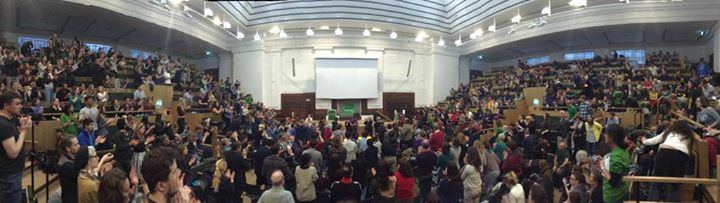
On Saturday 28 March a mass participatory gathering on climate change and the alternatives will be addressed by Naomi Klein, Russell Brand and many others. Dan Swain spoke to two of the organisers, Neil Faulkner and Marienna Pope-Weidemann.

Dan: Can you explain what the plans are for This Changes Everything, what you hope for the event and what you hope will come out of it?

Marienna: This Changes Everything is mass participatory gathering that will bring a thousand people together with activists and campaigners to debate some of the biggest questions of our generation. It’s about joining the dots between different elements of the crisis – war, poverty and climate change – joining the dots for a common solution, and finding ways to support each other in the struggle to make it possible.

It’s been organised by a network of independent activists, some already embedded in the movement, others not, brought together by the vision articulated by Naomi Klein’s new book. She’s highlighted the fact that the threat of climate change represents a historic opportunity for progressive politics, because the cornerstones of any socially just way out of the crisis vindicate much of what the Left’s been fighting for (and against) for generations. One Occupy Wall St organiser in the States put it well: it’s not about building a “separate climate movement, it’s about seizing the climate moment.”

Our organising group is pretty diverse, ranging from black bloc protesters to Green Party canvassers. That comes with challenges, but it’s all about building something broad and vibrant, more of a network-community than a ‘new coalition’. And what binds us together is an understanding of the need for system change – and an appreciation that to achieve it, we also need to voice a positive vision of the alternative. The byline we chose, ‘Democracy, Equality, Survival’ sums up the elements we want to see brought together: the system’s become so rabidly corrupt, so exploitative, so pathological, that those things can’t be won in isolation anymore. We achieve them together, or not at all.

Neil: Perhaps, in a wider sense, the concept represents a throwback to the looser, more bottom-up ways of organising represented by late 1960s movements like the American SDS, the 22 March Movement in Paris, the German SDS, and People’s Democracy in the North of Ireland. Another way of talking about it is to say that it is not quite like anything that currently exists – not a ‘united front’, not a single-issue campaign, not a party, certainly not a sect. Not least, it is a reaction to the plainly dysfunctional forms of ‘democratic centralism’ that characterise so much of the far left.

Speaking personally, I think we need mass revolutionary organisation in Britain. I cannot see any way out of the crisis – a compound crisis with ecological, economic, imperial/military, social, and political/democratic dimensions – which does not involve ending the rule of capital and establishing mass participatory democracy and rational control over the world’s resources in line with human need and planetary sustainability. So we need to build mass revolutionary organisation – mass organisation that aims explicitly for total system change to achieve social justice and climate justice. I see This Changes Everything as a stepping-stone towards that.

Dan: How do you see the relationship between This Changes Everything and the existing climate and environmental campaigns and organisations, from big NGOs to local anti-fracking campaigns?

Marienna: The climate movement has become very polarised in recent years, and particularly since the disaster of the 2009 Copenhagen Summit. Since the beginning I’ve thought of This Changes Everything as a response to a ‘red-green disconnect’ that’s emerged, mostly as a product of the dismal strategy adopted by more conservative elements of the climate movement. I see it as a priority for This Changes Everything to call some of the big green groups out on their silence because to the extent they have influence, they’re driving us down a dead end, because this system has got to go. Plus, beating the drum of ‘individual responsibility’ – blaming all our little actions and inactions equally instead of popularising the systemic critique and putting blame where it belongs is no way to build a movement. Not being clear about the problem makes it impossible to be clear about the solution. It breeds depression, political paralysis and resistance to change.

That said, the radical wing of the climate movement is a rising tide. From highly politicised indigenous movements on the front lines in the Global South, to the fantastic work being done by grassroots, anti-fracking and fuel poverty campaigns on the front lines here in the UK. A lot of great work is being done by people who understand that climate justice and social justice are now co-dependent, symbiotic. It’s not an alliance of distinct struggles to bulk up numbers: it’s one crisis, one movement, one vision. There is no radical Left manifesto that doesn’t have a solution to the climate crisis at its heart; and you cannot expect the environment to be treated with respect in a society where people are treated like trash.

Neil: There are three great forces in the modern world: globalised corporate capital; the militarised states; and the mass of working people. The first two form a unified bloc and are highly centralised. In fact, they are more centralised than ever before in human history. There is a vast gap between where most people live out their lives and the great concentrations of economic and political power like that represented by, say, the half dozen oil companies that dominate the global industry, or the ‘troika’ of EU, ECB, and IMF, or tax-havens and mega-casinos like the City of London.

We cannot fight the system effectively issue by issue, campaign by campaign, action by action. The system, and therefore the crisis, is an integrated whole. Power over the system is highly concentrated. We have to build united mass movements to confront that power if we are to have any chance of winning major victories.

Dan: I notice that the Young Greens are listed as supporters, and obviously they have received a big boost recently. What’s your assessment of the Greens as a political force?

Neil: The Greens have become the main electoral expression of what can be defined broadly as ‘anti-capitalist’ opinion in England. It is very good that people want to join and vote for an explicitly anti-neoliberal, anti-war, anti-climate change party. But it is not the solution to our problems. The fate of the Syriza Government in Greece – which has, in effect, capitulated to EU diktat within a month of getting elected – is a warning to us all. Breaking the power of the global corporations and the militarised states is going to involve a massive, protracted, complex historical struggle.

Marienna: In the long-term, the Green Party will be as good as its membership is active and part of the wider movement – because that’s how real change happens, and this is about so much more than getting the right people in government. That said, I think this explosion of support we’ve seen for the Green Party in Britain is really exciting. It reflects a lot of things, of course, not least war-weariness, concern for the environment and the impact of and resistance to austerity cuts – the Greens being the only major party in this country willing to take a stand on anything that matters anymore.

But it’s also about how the complete degradation of the Labour Party into an unrecognisable, neoliberal husk of its former self has opened a gaping hole in our political culture as far as parliamentary politics goes. People have known for a long time that the system is corrupt. They were content to vote for their ‘lesser evil’ because they couldn’t see any alternative. That’s what really excites me about the Greens: they represent a nationally visible, tangible alternative people are willing to go out and vote for. Join up to, even. Our job is to help people understand that the alternative is possible, but voting for it’s not enough: we’ll have to protest, occupy, strike and disobey to wrestle our economy back from the rich.

Dan: What about the existing far left? We all have links to that background, which is in a bit of a mess right now. What, if anything, can these organisations and traditions contribute?

Marienna: Neil said to me recently that after 40 years as an active revolutionary he’d finally come to the conclusion that “there is no formula for social change.” It’s true. Social change is as much an art as it is a science. We’re all learning as we go, but a huge part of that art is being able to treat people the way we think a better world might treat them: with respect. Without that we can’t have healthy political alliances or personal relationships. Nor can we grow, unless we create a culture, a community that people want to be part of.

Neil: I do speak very much as what I call a ‘refugee’ from the Old Left, which I was part of for 40 years. Organisationally the Old Left cannot really contribute anything. I am now convinced that you cannot graft new growth onto dead wood. The young activists think the Old Left sects and splinters are a joke. They are right. Individually we have to make an organisational break and set about building completely new organisations from the bottom up – organisations that are broad, inclusive, participatory, democratic, and dominated by young people. Small groups of non-sectarian revolutionaries should dissolve themselves into mass organisations of the kind I have been describing. Anything else simply prolongs the agony of slow and inevitable organisational death. There is no historical example of a small group setting itself up, proclaiming a ‘correct line’, and slowly becoming a mass party through something called ‘the primitive accumulation of cadre’. The way revolutionary parties emerge is through the crystallisation of revolutionary ideas and cadre inside mass organisations in the context of mass struggle.

Marienna: I think that those organisations and traditions can contribute to the extent that they can accept the need to create a culture people want to be part of, and listen to young people. When you can’t accept it, then you get the territorialism, the sectarianism, the antagonistic identity politics, the ‘I’m a better radical than you’. I think most people understand this is our greatest internal obstacle – but fewer seem to grasp that this calls for a deep cultural shift. One example: I think a lot of groups are losing the argument with radical young people about political organisation and formal membership. This cultural shift against formal organisation happened for a reason, there is a debate to be had and a new conclusion to be reached that reconciles the best of our tradition with the possibility of the present.

Basically, we need to start taking each other seriously if we want the world to take us seriously as a united force. I really hope that’s something that the existing far left can manage because there’s so much cumulative collective wisdom there and we can’t get it all from books! It’s also a culture I’d like to see This Changes Everything help cultivate – and people are telling me that what we’ve managed so far is a big part of why they’re making 28 March their first big political event.

Dan: Neil, you’ve spoken before about the importance of learning from history. Which historical experiences do you both think we should be focusing on today?

Neil: Well, there are so many, but here are two ideas: First, the Bolshevik experience has been the subject of the most grotesque caricature in the canon of post-war Trotskyism. Lenin was a democrat, and whenever possible – in 1905 and 1917 – he was in favour of mass participatory democracy in the party. Historical necessity has been turned into a theoretical dogma and used to justify an abusive and dysfunctional form of top-down internal party organisation. Indeed, modern forms of ‘democratic centralism’ have often been far worse than anything the Bolsheviks did.

Second, the Paris Commune. They did not have soviets or workers councils; they had a democracy based on geographical districts. Now, I strongly suspect, given the fragmentation of workplaces, communities, working lives, and so on, the growth of casualisation and high labour-turnover, and the relative weakening of the unions, that geographically-based mass democratic organs are more likely in a future revolution than industrially-based councils. We do not have mass strikes spilling onto the streets and becoming mass demonstrations or pickets. We have mass demonstrations which sometimes trigger what might be called ‘turnout’ strikes, like in Egypt during the Arab Spring revolution. The street, not the workplace, leads. So the Paris Commune may turn out to be a better guide to what a future revolutionary movement might look like than 1917 Petrograd.

Marienna: I think history is the most important lens to look through if you want to see clearly the how and why of the system we live in and how people behave within it. That said we are where we are, not where we were. Reform, revolution, social transformation – these are vastly complex processes we’re talking about, contingent on a picture we can never see completely. So I’m cautious about fetishising singular historical moments at the expense of learning from our global present and using our imaginations about the future. We need to talk more honestly about our shared history, be inspired by it and keep the best of it close. But we also need a new generation to take the lead by taking action and developing its own ideas about how we can change our world. And that’s another point for This Changes Everything’s to do list after 28 March!

Originally posted by RS21 on 24th March 2015

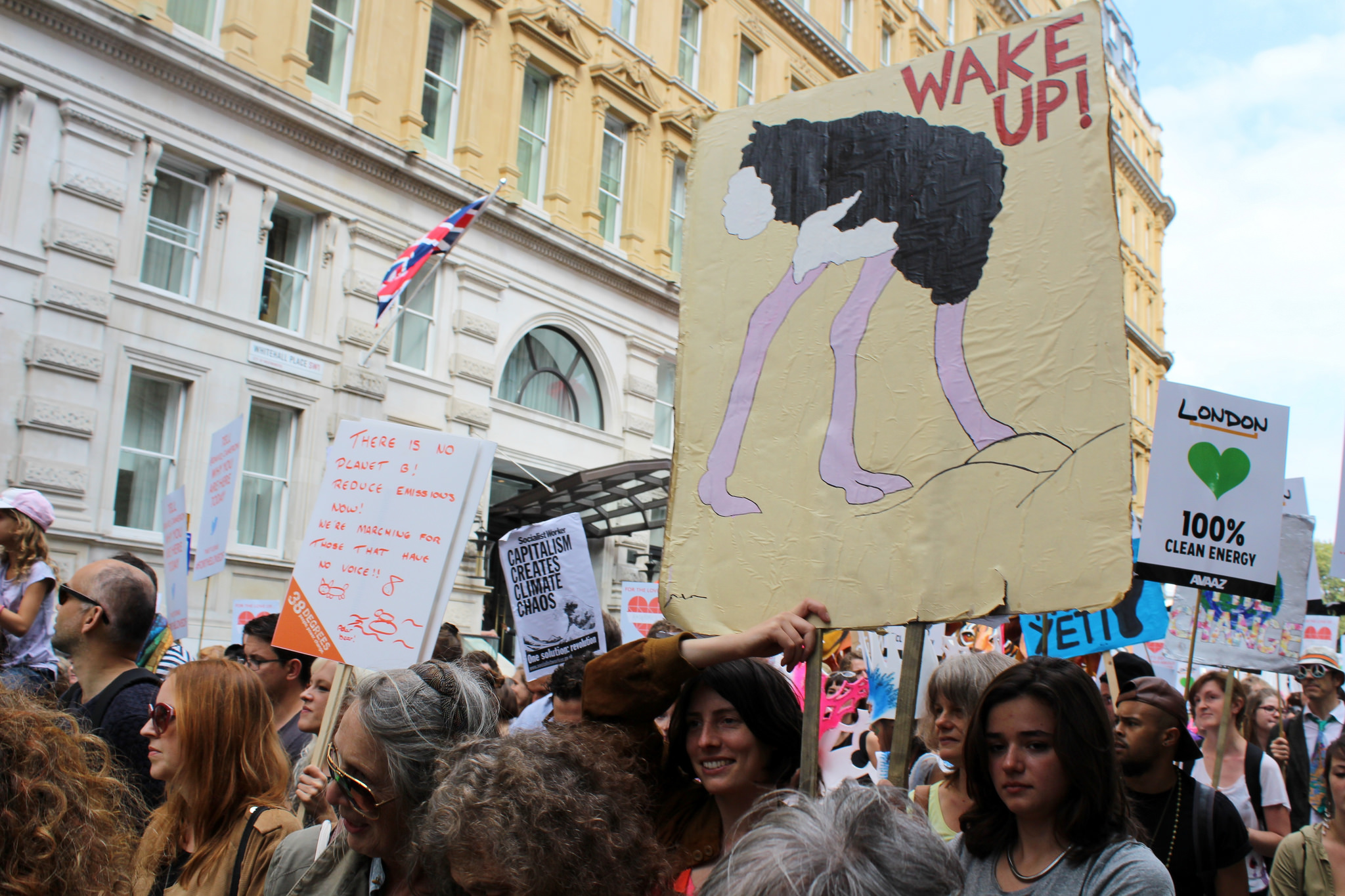
Photograph by Steve Eason, taken at the Time to Act Climate March, 7th March 2015
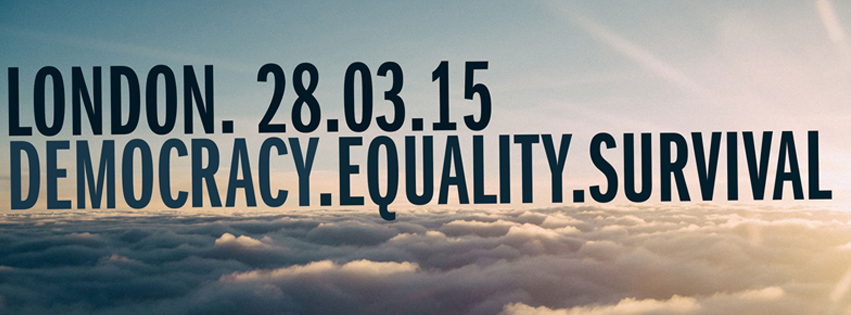
Democracy, Equality, and Survival: A Call to Action on March 28

fb cover (1)

Reading This Changes Everything, I started asking a lot of new questions. A number of us in the British student movement campaigning against war and austerity were increasingly perturbed by the lack of concern about climate change among some of our peers, even though we knew that extreme weather is displacing more people than war now, and that the destruction of the planet’s life-support systems would make it impossible for progressive politics to fulfill its promises. I was frustrated when activists cautioned: “The welfare of pandas and ice caps is a middle class concern. You just can’t mobilize around it.” Particularly maddening was a rather bleak sense that they had a point.

tce coverWhile the British Left may have been on the back foot since Thatcher, things had reached new lows for us twenty-somethings; we’d grown up with the relentless, televised War on Terror, and a Great Recession that should have discredited free-market fundamentalism but instead was being used as a battering ram to destroy what was left of the British welfare state. We had been reduced to defending the last of the gains made by our grandparents, things once taken for granted: universal rights “from the cradle to the grave.” Climate change seemed like one too many fronts to be fighting on.

My friend Francesca Martinez, the comedian and campaigner, often complained about this attitude: that there wasn’t any room in the Left’s agenda and anyway, climate change was too depressing and distant. For her, the problem was the lack of positive vision in a movement defined by what it opposed; speaking across the country, she encountered an appetite for an inspiring, justice-based alternative. And when a friend of mine (now my partner) showed me Naomi’s 2013 speech at the founding convention of the Canadian union UNIFOR, on why organized labor should join the climate fight, the implications of her message finally sank in: that this crisis was a historic opportunity, a planetary demand for system change.

Around the same time, some friends and I were launching a new project called Brick Lane Debates, to experiment with new ways to get people engaged with politics. Frustrated with both the passive lectures of the “Old Left” and horizontal forums too tied down in procedure to get much done, we wanted to synthesize good organization with meaningful participation. And we didn’t just want debate, we wanted music, comedy, culture; to build a vibrant, inclusive community animated by the ideas we thought could change the world.

Our first Brick Lane Debate was about climate change, and brought together a new constellation of campaigners with a growing group compelled to action by Naomi’s analysis. We had all joined the People’s Climate March, which provided beautiful, bold confirmation that you can mobilise around the climate. We were particularly inspired by the leading role played by organized labour in New York—but with honourable exceptions, it was largely absent in London. Unless we could join the dots between war, austerity, and climate catastrophe and quit leaving the environment to the environmentalists, we concluded, we would be giving up the single most powerful case for democratic system change we will ever see.

That’s the message that is striking a chord with growing numbers of young people. And that’s how This Changes Everything UK was born. March 28th will bring hundreds of people together with leading campaigners and climate scientists for a participatory gathering. At workshops taking inspiration from the Brick Lane Debates model, we’ll talk about the connections between the climate and economic crises, share visions for an alternative future, and discuss how to grow the social movements we need to get us there. From anti-poverty and environmental organizations like War on Want, Friends of the Earth, and the Young Greens, to radical campaigns like Fuel Poverty Action network, Occupy, and the newly launched Join The Dots, people are ready to stand up for all these ideas, together.

And the time is right, it seems to us, for such a symphony of radical voices to be heard. In the UK, the historic scale of the People’s Climate March was just the beginning. Vigorous grassroots campaigns against fracking have been erupting in sleepy rural communities. And the recent surge in Green Party membership here reflects not only concern for the climate, but also deep disillusionment with the narratives being regurgitated by our political establishment and their megaphones in the mainstream media. Public trust in government, the press, and the police has never been lower, while participation in political protest is at an all-time high. Meanwhile, we see progressive coalitions transforming the political landscape in Greece and Spain.

Old assumptions about what is impossible or inevitable, or what people have the capacity to care about, have no place in the new movements that are emerging. If there was ever a moment to change everything, it’s now.

tcepanaorama

***

Like us on Facebook and follow @TCEuk on Twitter. We’re still organizing the format and structure of the March 28th gathering, so if you’d like to get involved or think your organization could help lead one of our workshops, drop us an email at thischangeseverything2015@gmail.com.

Originally posted by thischangeseverything.org on 24th Febuary 2015fb cover (1)

Facing Up to the Climate Crisis Part II: The Great Green Wash

Nature may ‘not discriminate’, but capitalism does. It will be the social classes – and countries – with the least responsibility for climate change will be hit first, and hardest. In 2004 the British government’s Office of Science and Technology produced its report, Future Flooding, which predicted up to 3.6 million Britons at risk of severe flooding by 2080 thanks to rising sea levels and rainfall. ‘Socially disadvantaged people will be most adversely affected’ it admits, because ‘the poor are less able to take out insurance against floods or to pay for the damage.’

15292219060_7bee7bec9a_kThis logic applies far more drastically to the global South. Even a 2°C rise in temperatures will create a global refugee crisis and hit agriculture internationally – a food system centralised, standardised and rendered utterly inadequate by the profit motive. Our capacity to adapt is reduced every day the free market has the run of food production. This has already undermined biodiversity to the point where three quarters of all cultivated plants are now extinct and their inferior, genetically modified substitutes are locked up in highly profitable intellectual property rights and free trade deals. Food prices will skyrocket and people will starve.

There has been a tendency in this debate to lay climate change at the feet of humanity as a whole and ‘progress’ as a concept. ‘Anthropological climate change’, they call it. But most of human history has been shaped by a world of scarcity, not the hyper-consumerism and over-production that we see around us in rich industrial nations. And let’s not forget, for 3 billion people on this planet, scarcity and deprivation still define the world. The climate change narrative of the global North is not the only story; the under-development of the South and exploitation of the poor in every country are as much a part of the system as wasteful consumerism.

Capitalism is different from what came before. No previous society has accumulated and concentrated wealth on a comparable scale. The ecological crisis is a symptom, the most deadly symptom, of a social crisis in human beings’ relationship to our environment. It makes more sense to talk of capitalist, rather than anthropogenic climate change.

In contrast, the culture of general responsibility that’s been cultivated by environmentalists like Hans Jonas has undermined the green movement in some very significant ways. In zeroing in on ‘consumer culture’ it fails to strike a chord with many. Millions of us living in this wealthy, competitive, consumerist society are working hard and still have to choose between eating and heating our homes. In that context, ‘consume less!’ is not a rousing carrion call. Particularly not when the carnival of consumption at the top of society has just rolled right over its own global financial crisis and wastes resources at an industrial rate. It is an argument utterly insensitive to the realities of working class life. At its worst, it scapegoats the poor while protecting the sensibilities of wealthy benefactors like Coca-Cola and Unilever.

Whenever it is articulated as a matter of personal moderation or asceticism, the campaign against climate change draws a curtain over the very worst of the capitalist system. It obscures the starring role corruption, inequality and exploitation. It creates confusion, helplessness and guilt. The political culture of neoliberalism has a gift for that. You can see it in the shame people are made to feel when driven to food bank in their thousands, in a rich free market where anyone can succeed if they deserve to. The neoliberal art is the individualisation of social problems. And well it might be, because it has to answer for an 80% increase in global emissions since 1970.

This is not about whether small actions by individuals – recycling the rubbish, cycling to work – have value, they do. But the value is symbolic. In an act like that we can advocate transition, but we can’t achieve it. The systemic wastage of our entire economic system, from production and construction to energy and consumption, play the overwhelming and decisive role in destroying the planet. To be clear: system change will require everyone to accommodate changes in the way we live, travel and consume. But it’s not an annual Ryanair flight to Costa Rica that’s blowing holes in the ozone layer. The really inconvenient truth is that individual acts count for nothing unless the system changes too. And pretending otherwise has crippled the campaign to stop climate change.

As Howard Zinn said, “you can’t be neutral on a moving train.” No matter how small you make your carbon footprint, this train is still speeding over a cliff. We have to start talking about the system, or there is no hope for change. Already what use was ever made of renewable energy has been almost eradicated by standardising production for bigger profits. Yet that exact capacity of human beings to make conscious changes to the way we reproduce our existence is what makes change possible.

15292246928_3e532a1429_kOn the other hand, obfuscating the power of wealth and class not only divides the movement, it naturalises climate change. It is not natural law that productivity or population growth threatens the environment. Natural fertilisers that make farm land more productive without damaging the ecosystem were a historic discovery of the 15th century. Whether every ounce of profit is squeezed out of an innovation or it’s used to more efficiently meet the real needs of the population and minimise deforestation – that’s a choice we make collectively, as a society. The insanity lies in thinking that activity which harms our environment or our species can be classified as ‘growth’ of any kind.

Reactionary arguments from the likes of Jeffrey Sachs about population exceeding the ‘carrying capacity’ of the earth are a direct result of this refusal to look capitalism in the eye. Non-coercive population reduction strategies such as improving women’s living standards, education and access to contraception have proved successful and should be valued on many counts. But demographic change is slow, and the need to curb our carbon emissions is immediate.

Given that context, challenging the right to life for millions should not come before challenging capitalism. This is the tone of discussion in Washington memos that describe the US as a ‘fortress’ amongst the anarchy of a world consumed by flood, fire and war that re-balances the earth’s ‘carrying capacity’ through mass-extinction. Yes we live on a finite planet and no, it can’t support an infinite amount of life. But that capacity is determined first now by how many life, but how we live. At present we live in a society that produces far more than we need it to and still manages to deprive most of us of the basics.

‘Productivism’ – production for its own sake, for profit – prevails in this world because capitalism is a system based on accumulation. In such a system, innovation in productivity will only ever mean more production, market expansion and the manufacture of consumer demand to meet it. This is an inevitable consequence of the private ownership of the means of production. As the renowned economist Joseph Schumpeter observed: “A stationary capitalism is a contradiction in terms.” We cannot obtain meaningful environmental regulation within capitalism for the same reason we can’t achieve meaningful financial regulation. As Marx wrote in his Critique of Political Economy, “capital cannot abide a limit.” It will always seek to circumvent or transcend it in pursuit of greater profits.

Steady state theorists who argue for an end to population and economic growth, have been miles ahead of the Left in identifying the immediate significance of the planet’s natural limits. But the tradition has a frightening right-wing current. It has done since it began with Thomas Malthus in the 1700s. Thanks to this political lineage, too often those who focus on population and consumption ignore poverty and the ‘consumerist’ struggles for better pay and conditions that it breeds. There are honourable exceptions, like George Monbiot, Peter Victor and Caroline Lucas, who incorporate a respect for ecological limits within a relevant political perspective and broader concern with social justice. Still, not only would any movement that relied on the panacea of no-growth have little relevance for the global South, which demands its right to development; it excludes millions in the North blighted by poverty, unemployment and exclusion. We could build a growth-less system with a static population, at peace with the earth but characterised by all the inequality and oppression of today; but that’s not sufficient to inspire the mass-participation required to get us there.

At the end of the day the steady state is not a complete social project, or even a campaign – just a (vital and urgent) quantitative constraint. Capping growth is not enough; we need all sections of society drawn into a complete, collective re-definition of what we mean by ‘economic progress’. That means extending a critique of capitalism to its very heart: its law of value which makes money the aim and the measure of all life on earth.

I would put the case, as Naomi Klein, Daniel Tanuro and others have done, that climate change is the best illustration of where the capitalist system is heading and the most powerful case against it. Any kind of reconciliation with the climate would require the abandonment of $20 trillion existing fossil fuel infrastructure and 80% known fossil fuel reserves (all owned by corporations), de-centralisation, reduced production and working hours and a massive equalisation of wealth – all entAllirely opposed to the interests of the capitalist system. Only a society which puts the economy under democratic control and recognises equality as a pre-condition for such democracy, can move beyond the paradigm of commodity production and even identify – let alone protect – that which is priceless.

15478513492_6d2ac99a4f_kYou can read Part I here

Originally published by the Huffington Post

All photography my own

Facing Up to the Climate Crisis Part I: Capitalism vs. the World

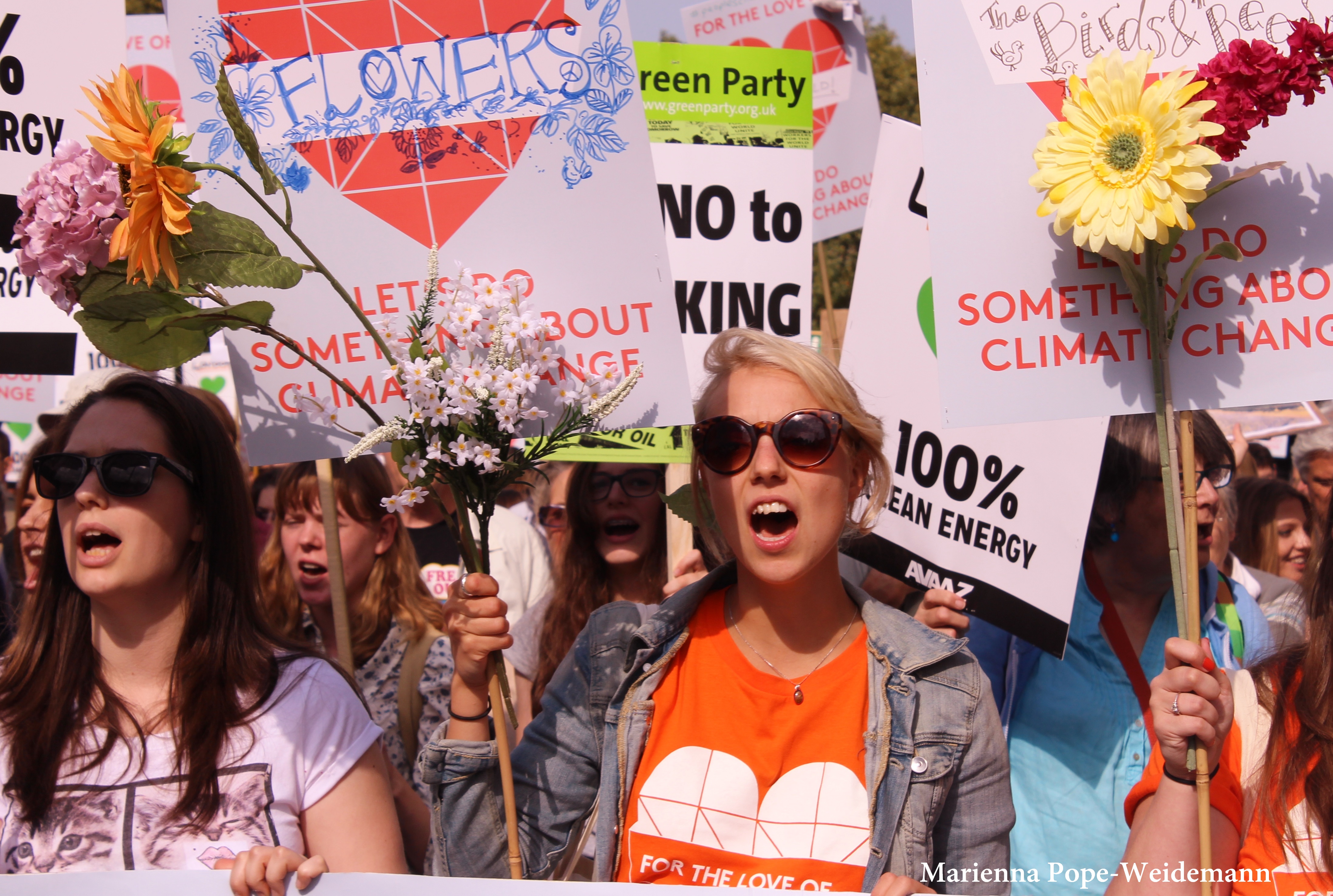
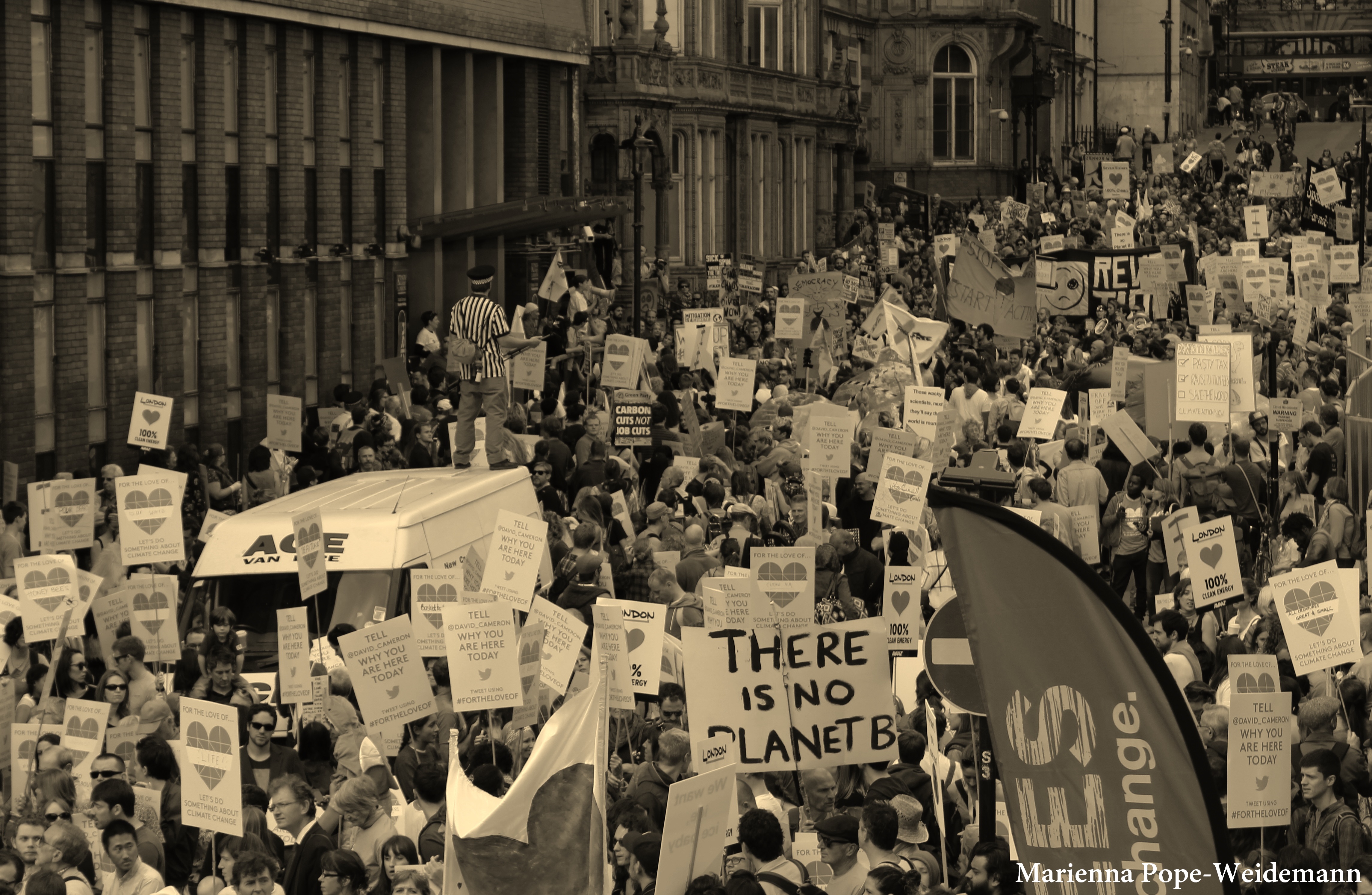
The impossible is happening. The People’s Climate March was a global day of action of historic proportions. Over 30,000 people took to the streets in London. New York City hosted the biggest march climate march ever, with religious and labour leaders coming together with scientists, environmentalists and 400,000 Americans. People protested in 166 countries demanding system change. Even the Rockerfellers are divesting (sort of). In Paris just over a year from now, the UN will be holding its Climate Change Conference, widely considered by experts to be our last chance to reach a radical and binding agreement on carbon emissions before planetary catastrophe becomes unavoidable. So if there was ever a movement who’s moment had come, it’s this one and it’s now.

PCM 1

Yet much like the system it challenges, this is a movement filled with contradictions. Is it a movement against capitalism, or a movement within it? We live in a world where Coca-cola, a corporation which hires thugs to murder trade unionists in Latin America and systematically steals drinking water from India’s poor, can be considered a legitimate partner to ‘save the polar bears’ by WWF; where Unilever, one of the world’s most powerful corporations and leading food monopoly with an atrocious labour and environmental record, ends up sponsoring the People’s Climate March. Much depends on where we draw our lines.

The American Dream of pointless over-production, which offers thirty kinds of smartphone all designed to break down but can’t allocate the resources to keep our local libraries and hospitals open – that dream has been globalised, and they call it ‘economic growth’. Co2 emissions, driven by deforestation (at a rate of around 36 football fields per minute) and the burning of fossil fuels, have reached historic and deadly levels. By even the conservative estimates of the IPCC, this will flood major cities, destroy whole societies, create a global refugee and food production crisis – it will change the world forever, unless we start reducing emissions within the next year and leave 80% of known (and owned) fossil fuel reserves in the ground. But despite all the campaigns and the summits, to recover from the financial crash within the confines of capitalism, global emissions were allowed to shoot up in 2010 at a faster rate than at any time since the Industrial Revolution.

All solutions are viewed through the lens of, and ul15478612912_fb82c841d5_ktimately nullified by, the demands of commercial viability. We see this battle between cost efficiency and actual efficiency being played everywhere in the market’s warped attempts to tackle global warming by promoting the worst and most inadequate alternatives – from ecologically destructive, inefficient and expensive biofuels undermining food security in the South, to the dangers of nuclear power in a highly militarised capitalism which cuts corners whenever it can afford to. The result, to quote Ban Ki-Moon who seems to grasp the consequence if not the cause, is that “we have our feet glued to the accelerator and are hurtling towards the abyss.”

It’s been the same with carbon trading, a climate-saving measure reduced to a money-making slot machine. Total emissions keep rising while hospitals and universities are obliged to buy extra credit, big business is making money trading and gambling on the carbon market while energy companies pass the costs onto consumers. The price on emissions, by IPCC estimates, is five times too small to discourage the Big Polluters. But perhaps worst of all, current rates are big enough to create an apparent conflict of interest between the climate and the majority of working people who struggle to pay their energy bills.

PCM 3

The danger is real, immanent and almost too big to comprehend. For twenty years, the science has been ignored while campaigners work to wrestle concessions from a political system held hostage by big business – and with an annual profit of at least €1,325 billion per year (equivalent to the GDP of France), there’s no business bigger than the hydrocarbon business. Corporations have bought off scientists, journalists and politicians left right and centre. As leading climate scientist James Hansen put it to the US congress, “CEOs of fossil energy companies know what they are doing… [they] should be tried for high crimes against humanity and nature.”

But whether it is more ‘pragmatic’ to tackle capitalism explicitly or to ignore it, is a question of whether it’s possible for climate constraints to be respected following strategies determined by commercial potential. The answer, in short, is a resounding ‘no’. That is simply not possible in an economy dominated by corporate interests whose nature is to exploit catastrophe rather than prevent it. The UNDP estimates that genuinely ecological economic development of the South would require an $86 billion per year wealth transfer from North bypass reliance on fossil fuels – and capital flows are still moving in the opposite direction. That corporate monopolies of intellectual property rights have been allowed to obstruct this transition and save millions of lives is a supreme indictment of the free-market system. The Big Six agribusiness multinationals are already patenting ‘climate change crops’ at a rate of knots.

We saw when the poor were left to fend for themselves during Hurricane Katrina, how ill-equipped the market system is to protect even ‘the Western poor’. In fact New Orleans’ budget for sea wall maintenance was cut from 2003 to finance the War on Terror, during which they were receiving a sixth of the funds they requested. Separating the hurricane from its political context is impossible, and there is a lesson in that.

The 2009 Copenhagen Summit was a final straw for many. The world watched as the emphasis slid from stopping global warming to funding ‘adaptation’ – grants and loans extended mostly by the countries responsible for past and present global warming, to those most endangered by it. Funding is determined not by need, of course, but by their openness to ‘clean’ investments from Northern multinationals. Even though world’s oldest industrial powers are overwhelmingly responsible for historical and current climate change, Western leaders have the gall to offer IMF loans parcelled in exploitative conditionality agreements to help poorer countries pursue ‘sustainable development’. The delegate from Tuvalu famously equated the funds with Judas’ thirty pieces of silver. More than that, it’s the mass crime against humanity that will define our times and it will cost millions of lives. It’s time to make a change.

15291995739_5d2b65981b_kClick here to read Part II

Thanks go to the following authors, who’ve done excellent work on this subject on which this series of articles draws heavily: Naomi Klein, Daniel Tanuro, George Monbiot, Vandana Shiva & John Bellamy-Foster.

Originally published by the Huffington Post

All photography my own

Ten Reasons to Get Active & Stop TTIP

The Transatlantic Trade and Investment Partnership (TTIP) will be the biggest international ‘free-trade deal’ in history. It will standardise EU regulations with their almost non-existent US counterparts. Negotiations are secret and over 90 per cent consultants are corporate lobbyists, which is more than a little suspicious.

After decades of deregulation, this time the corporations are launching a direct assault on the very principles of environmental regulation, public services, labour rights, civil liberties, environmental and banking regulation (of course), and even basic safety standards for the food we eat. As if that’s not enough, it will also give multinational corporations the power to sue democratically elected governments for implementing any policy that threatens their profit margins – even if those are the polices we voted for. It’s no exaggeration to say that almost every legislative victory won by progressive forces since the Second World War has cause for concern over TTIP.

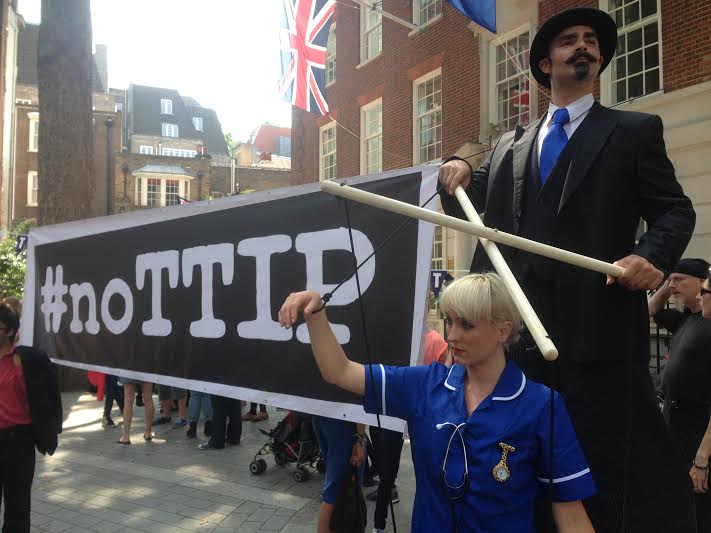
ttip

Today a national day of action called by No to TTIP brought about 700 protesters to the Business Innovation and Skills Centre in central London to protest as local actions were held across the country. The London contingent marched to Smith Square and hosted its own football match (corporates vs. greens) with a carnival atmosphere cultivated by circus acts and face painting.

The demonstrators heard from comedian Mark Thomas, the writer David Graeber, and Green MEP Jean Lambert, plus speakers from Friends of the Earth, the World Development Movement and War on Want. The day followed a successful national tour of public events, but the campaign is only just beginning, so show your support and get involved…

Top 10 reasons to get active and stop TTIP

1. Banking deregulation – and the further reduction of capital controls and undermining of what little regulation has been introduced since the financial crisis, has of course been aggressively driven by the British government on behalf of its financial sector allies. Back in 1999, the repeal of the Glass-Steagall Act didn’t get much press – it doesn’t exactly roll off the tongue. It had been in place since 1932, meant to prevent a repeat of the Great Depression by separating the carnival of casino investment from our high-street banks. Eight years later, the global economy was trashed again by the same financial sector interests that broke it in 1929. There’s a moral to the story which applies to TTIP: if it sounds more technical than political and international finance is pushing for it, it’s a threat. We learned that lesson in 2007-8…

2. A threat to jobs & labour rights – while Cameron promises TTIP will create jobs, its Western equivalent, the North American Free Trade Agreement (NAFTA) between the US, Canada and Mexico contributed to rising poverty and unemployment across the board, costing an estimated 1 million American jobs. The European Commission itself admits TTIP will encourage corporations to go to the US and wherever labour is cheapest and unions weakest, galvanising a global race to the bottom, pushing wages down even further and causing ‘prolonged and substantial’ dislocation for European workers.

3. The end of public services – worsening the threat of poverty and unemployment is the destruction of social safety nets, as the red carpet is rolled out for US companies to bid for healthcare contracts threatening to ‘destroy the NHS’ according to some MPs. Leaked documents have exposed the lack of any safeguards to defend such basic services. TTIP threatens to stand the whole anti-cuts movement on quicksand, pitting the movement to reverse privatisation against international law itself. The corporate onslaught against Slovakia‘s relatively leftist government since 2006 foreshadow what’s to come – already one foreign private healthcare company has seized €29.5 million in public assets for their attempt to limit private profiteering in healthcare, and another is trying to block the Slovak government from providing universal healthcare cover.

4. Civil liberties – remember the Anti-Counterfeiting Trade Agreement, rejected by the European Parliament following massive public opposition? Thanks to Wikileaks, we know that TTIP threatens to slip in key elements of it under the table, undermining data privacy laws and forcing internet service providers to monitor copyright infringement and threatening exemptions for schools, libraries and the disabled. More draconian restrictions on intellectual property can restrict access to essential goods, from food crops to medicines, for millions around the world.

5. Destroying the planet – threatens environmental regulations of all kinds, and is expected to add an extra 11 million metric tons of CO2 emissions, undermining the incremental steps the EU took under the Kyoto Protocol. Leaks have also revealed TTIP also opens the flood gates for mass exportation of oil from the Canadian tar sads, as well as shale gas from fracking in the USA, effectively putting a ball and chain on environmental and community campaigns in both countries while normalising these damaging and dangerous practices here in the UK. Of course the government is quick to point out that the degradation of our ecosystem and basic conditions for life on this planet is acceptable because we’ll end up with lower gas prices – assuming energy companies pass their savings onto consumers (which they don’t tend to do). Sure, maybe some of us can shop around – but as Jeremy Hardy says, it ends up like match.com: you evaluate an endless stream of pretty unappealing options until you get so tired you end up getting screwed by one of them.

6. Poisoning your food – TTIP will also set us on the road to American supermarket isles, where genetically modified foods and meat treated with hormones and growth promoters will not only be on the shelf, but might not even be labelled as such. Environmental impacts and animal welfare will also likely slide off the bottom of the agenda. Research has shown these products can pose grave threats to human health, animal welfare and the natural environment. Public opposition and safety concerns were at the heart of making them illegal under EU law.

7. Stealing from the South – if it passes, the introduction of TTIP will re-double pressure on developing countries to adopt the same (lack of) standards and really put the ‘shock’ back in the shock doctrine. It will marginalise developing economies like India, China and Brazil while robbing poor countries of what little sovereignty they have left over their economies. For much of the global population it will lead to worsening poverty, dispossession and instability.

8. Destroying our democracy – TTIP will legalise ‘investor-state disputes‘ allowing companies to sue governments at taxpayers’ expense in corporate courts whenever their policies undermine corporate profits – anything from re-nationalising key industries and public services (like the NHS) to preserving existing regulations on wages, corporation tax and environmental protection. Trying to articulate alternatives in the face of a suffocating political consensus on cuts and neoliberalism is hard enough, without it being enshrined in international law. Thanks to NAFTA, Canada has been sued $250 million by a US energy company for respecting Quebec’s referendum against fracking.

9. America – you have to hand it to the USA: it’s a brave new world over there. Despite being the world’s richest economy and strongest superpower, it’s the most unequal country in the developed world. TTIP is about letting the corporations that profit from that mess run rampant throughout the world, and dragging our regulatory standards down to their level. It leads the West in levels of incarceration, mental health problems and violent crime. It’s also managed to maintain some of the poorest health standards in the developed world alongside the most expensive and least effective healthcare system. As any progressive American can tell you – we don’t want to go there. But that’s where we’re headed.

10. The race is on – TTIP was not supposed to enter the public domain, but documents have been leaked by Green MEPs, Wikileaks and others. Now it’s been exposed, people across the world are taking action. One of the downsides of trade deal that will impact so many different sections of society for so many different reasons is that it creates a lot of common ground for progressive campaigns. As a threat to social justice, civil liberties and the environment, TTIP should be seen as a natural unifier, as illustrated by the broad range of organisations pledging support – from the People’s Assembly and War on Want to STOPAIDS and the Jubilee Debt Campaign. It comes at a time when building broad-based opposition to the neoliberal agenda has never been more urgent. If TTIP passes, it will strike at the heart of everything the left is fighting for. A trans-Atlantic threat calls for trans-Atlantic resistance, as it looks increasingly like all these campaigns will be won, or lost, together.

Published by the Huffington Post 12/07/2014

DOCUMENTARY: Watching the Watchers – Exposing the Secret Surveillance State

The Snowden leaks have revealed some of the darkest secrets of the British and American intelligence agencies. From dignitaries and dissidents to ordinary people, online and on the phone, we are all being watched. Are our privacy and civil rights being compromised, or is this a necessary line of defence in the war on terror? Shining a light in the darkest of places, we tell the story of the secret surveillance state and those who exposed it.


Tweet about the film/check for updates: #watchingwatchers

Lessons from the Snowden Leaks

The surveillance programmes exposed by Edward Snowden reinvented the term ‘Orwellian’. Yet while in the USA thousands marched in solidarity with Snowden and against what he exposed; congressmen demanded resignations from their spy chiefs; and authoritative institutions ruled bulk data collection illegal – in London, with honourable exception, all I hear is crickets; and the sound of Britain sliding to 33rd place in the Press Freedom Index. That silence is as much a threat to civil liberties as the surveillance itself. 

snowdenpic38 Degrees’ petition demanding a public inquiry into the Tempora surveillance programme is stalling before 5,000 signatures despite the fact leading intellectuals, journalists, political leaders and human rights groups have vigorously condemned it. Leaks proved it was kept secret precisely because Government Communications Headquarters (GCHQ) anticipated a strong legal challenge against this gross violation of civil rights. But instead they’re getting away with it, and journalists are the ones taking the heat.

The US may be engaged in a witch hunt but Snowden still enjoys a higher approval rating at home than either Obama or Congress, while in the UK, less than 20 per cent of people consider the surveillance state too intrusive and most disapproved of the leaks. Unlike Washington, Berlin, Paris, even Jakarta – we’ve had no mass protests either. This is partly a problem of coverage – while scandal after scandal has blazed across the front pages of all Europe and rocked administrations from Berlin to Jakarta, they are being systematically ignored by the bulk of the British media. But there is more to it than that.

Not six weeks into my first job and I was on the phone to GCHQ, the most guarded faction of the British secret service. I was requesting an interview for my film Watching the Watchers, assuming, correctly, that if they said no to Glen Greenwald, they’d say no to me – but it was worth a shot. The Guardian was more helpful. I paid a visit to their London offices for my first interview, with their resident expert and former security editor, Richard Norton-Taylor. He reeled off an impressive list of case studies: torture, extraordinary rendition and war crimes; arms deals with foreign dictators; spying on peaceful campaigners and blackmailing journalists into betraying their sources. But what really hit home for me astute observation that governments, when they need to conceal embarrassing or illegal activity, will always ‘fly the flag of national security’ because it invokes deference.

This has been a strong historical tendency in British political culture. Britain has more CCTV cameras per inhabitant than any other country in the world and, as one Spiegel journalist wrote, many Brits see GCHQ as the: “amiable gentlemen in shabby tweed jackets who cracked the Nazis’ Enigma coding machine in World War II” – even if they have launched the most ambitious programme of global surveillance in history.

When the Guardian’s editor-in-chief, Alan Rusbridger, was being grilled over the leaks by a home affairs select committee, he was interrupted mid-sentence by the voice of Jo McCarthy, who had apparently possessed the body of Labour’s Keith Vaz. “Do you love this country?” it demanded. If we had a constitution that enshrined our civil right to privacy (or a Human Rights Act our prime minister wasn’t trying to wriggle out of,) things might get muddy here. But for men like that, Project Tempora is just an expedient line of defence in an endless and borderless war on terror. And if that terrifies you, or you simply maintain that the public has the right to what Snowden gave us – the chance to decide – well, that’s just unpatriotic. Rusbridger’s response was artful. We are patriots, he affirmed, and one of the things we are most patriotic about is our tradition of respect for democracy and press freedom.

David Cameron claims the Guardian’s coverage of the NSA leaks shows no sense of ‘social responsibility’. In fact, it has proven the Guardian to be one of the few mainstream media outlets left in this country with any semblance of social responsibility left. Increasingly news is seen as a product and citizens as consumers instead of participants in a dialogue that should be directing our elected representatives. No wonder then, that three quarters of people in Britain think the mainstream media ‘sometimes or frequently lies’ to their audience.

This question of defining the media’s responsibility is also the missing link in the debates around press reform. Bending the rules for stories that might sell papers but serves no real purpose – like the phone-hacking of Milly Dowler – is indefensible. But if the Watergate Scandal had been broken by a phone hack, would the ends not justify the means? If blowing the whistle was what it took to expose illegal MP expense claims (which it was) or secret US bombings designed to perpetuate the Vietnam War (which it was) then they are best considered acts of courage. And if similar tactics had been able to prevent the Iraq War by exposing the truth about weapons of mass destruction, that would be grounds for a Nobel Peace Prize.

In time it will become clear that we all owe a debt of gratitude to Edward Snowden, who has done us an immeasurable service and demonstrated that, even working at the heart of the secret state, people are not machines. However powerful the pressure to conform, to take the cheque and keep quiet, there will always be those who, moved by injustice, will speak out. But it counts for little, unless we all speak out together.

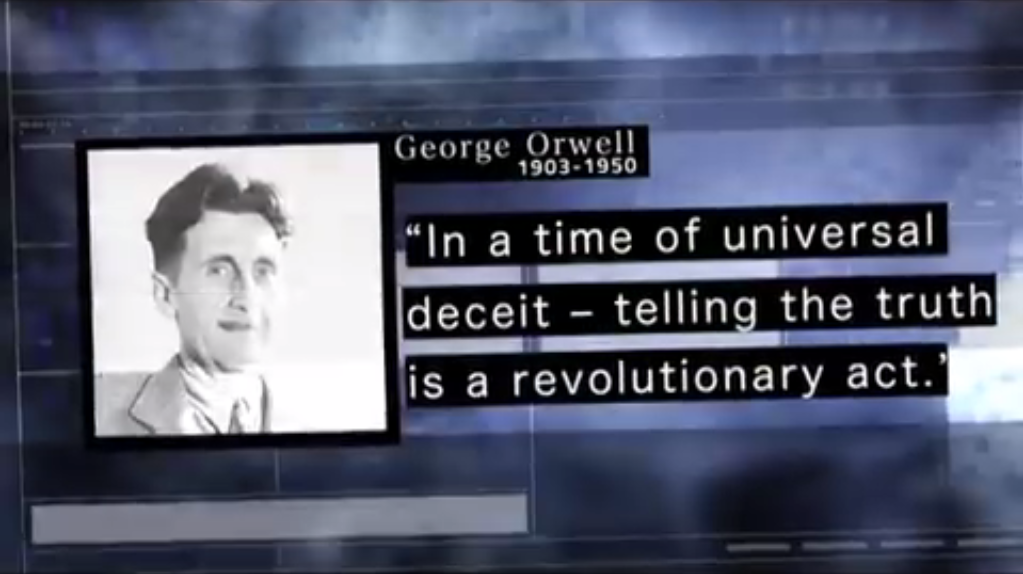
orwellquote

Originally published by the Huffington Post 10/04/2014

Stop the Student Sell Off

After four years as a SOAS student, I’m about to graduate with a considerable amount of debt, albeit not compared to those now paying historic £9000 tuition fees. If you borrowed money from the government between 1998 and 2012 to pay for your education, George Osborne has, or intends to sell your debt on to banks and private companies. The government has already sold off all pre-1998 loans – worth around £900million – at a massive loss to the public purse. The rest of us will make them around £40billion.

The sell-off will transfer millions from public education into the pockets of private companies. With most students already graduating with over £50,000 student debt thanks to fees, cost of living and youth unemployment rising about as fast as the value of a university education is falling. That is money they said they needed for schools and universities. But this move embodies the complete disdain this government has for the very principle of universal, public education. They fear it because, to quote Nelson Mandela, “education is the most powerful weapon which you can use to change the world.”

They think they have a mandate to do what they like with education now now. Ever since the carnival of fraud, greed and negligence that is free-market finance sent the global economy into cardiac arrest (again) and was bailed out to the tune of £130billion the establishment has been calling it ‘national debt’, a ‘structural deficit’, an ‘imbalance on *our* credit card’ – whatever the line is that best offers an excuse to sell the public services won by people in Britain after World War II. Which they really rather want to do.IMG_8215

#StopTheSellOff

It took a Freedom of Information request to get any documentation on the student loan sell-off in front of the public, and even then 90% was redacted. The government has made its promises about leaving interest rates alone (while reserving the right not to), but we know what their promises are worth – students have not forgotten Nick Clegg’s historic betrayal over fees, and Cameron’s abolition of the Educational Maintenance Allowance.

Though billed as a money-saving measure, the sell-off is no such thing. The Higher Education Policy Institute has concluded in its report that the policy is based on ‘highly uncertain and optimistic assumptions’ and underestimates the cost to the public because it fails to account for the fact that once in private hands, the government makes nothing on interest repayments. Like rising fees, privatisation costs far more in the long run than it saves in the short – never mind the social cost.

The British education system has always been one of the most stratified in the world. But the neoliberal restructuring now underway throughout education, disempowering students & staff while opening up universities to private investment (and all the strings that come with it) threatens to shift university forever out of the realm of right and into that of privilege.

This restructuring, combined with savage and politically motivated cuts to public funding impoverishing all but the most ‘fiscally viable’ departments, all falls within the broader context of the Tories’ calls for Permanent Austerity – not to pay back the deficit, but to normalise for the next generation a system in which fundamental rights, to education, healthcare and security, are reserved for those who can afford it. This is not just about what kind of education we want, but what kind of society we want for those that come after us.

When they said Cut Back – we said Fight Back

Losing the tuition fee vote in parliament on ‘Day X’ in 2010 – the climax of the student revolt – was my induction into student politics (not the most inspiring moment to show up). But in the years that followed I probably spent a greater proportion of my time on political activity than actual studying.

I was always pestered by the thought of my little cousins back home, too intimidated by the growing financial barriers to risk of ‘investing’ in their education; or as graduates sunk beneath toxic debt-burden that threatened their homes, their families; robbed them of their independence and forced them by the necessity of survival to accept the materialistic, careerist values of the Neoliberal Age rather than follow their passion, as I had. My grandmother had always impressed upon me the importance of education as the key to freedom, especially for girls. She had wanted to study astrophysics but her working class Mancunian background put it far beyond her reach (not that women were allowed to study physics back then anyway).

My sense of that history, and fears for the future, made a powerful motivator that I feel as keenly now as when I started. The students are the lucky ones, I reasoned, and that gave us an obligation to fight for what our grandparents fought for after the war, and is now being stolen from us. The myth of dignity and security “from cradle to grave” is dead – what we are witnessing in Britain today is the worst decline in living standards since the 19th century. Child poverty is at its highest now since the war. Not since Queen Victoria has inequality in this country been so vast. The government’s austerity policy amounts to a systematic and spectacular theft by 1 per cent; but it is generating resistance.

99% of us Are In It Together

The Student Assembly Against Austerity, now backed by the National Union of Students, has been building a campaign of resistance to the sell-off on campuses up and down the country. We successfully petitioned 75 MPs to sign an early day motion against the sell off and coordinated a national week of action in February, with students taking action in over 50 universities, going into occupation at Exeter University and holding a protest and ‘debt-in’ in central London.

Student protests against privatisation and the real decline in staff wages have prompted an escalation of the campaign by management and police to criminalise it, which climaxed with mass arrests of students in central London last December. Ultimately, the students’ success will depend on our reaching beyond campus and taking a leading role in the broader resistance to austerity, which in so many other ways is exploiting the 99% to pay for a crisis created by the 1%.

The People’s Assembly Against Austerity is now the largest anti-cuts coalition in the country uniting social justice campaigns, trade unions and community groups in opposition to cuts across the board. That the Metropolitan Police is now deploying water cannon on the streets of London for the first time explicitly to ‘control protest against on-going and potential future austerity measures’ shows that they know what we know: that the potential is there for a mass movement of people in this country who will not stand for the trashing of public education any more than the dismantling of the NHS, the emergency services, the libraries and public spaces, the abolition of the welfare state or the rise of right-wing racism that follows. The Student Assembly will be playing a central role in these campaigns moving forward while we continue to fight the student loan sell off.

The students were alone in 2010. We were the first to come out on the streets. But now there is a movement of resistance building real national force and giving us the collective potential to take on the government – and win. So whether it’s on your campus or in your local community – get involved, and march with us on 21st June from the BBC that has too long ignored us, to a festival of resistance outside the parliament that is counting on us giving up and going home. They shouldn’t hold their breath.

IMG_8311

Originally published by the Huffington Post 12/06/2014

All photography my own

UPDATE: the privatisation of the student loan book was subsequently dropped

With You in Gaza

(Circa 2014 Offensive on Gaza, a.k.a. ‘Operation Protective Edge’)

We are with you in Gaza

Where UN resolutions are good for nothing

But stitching into tents for your refugees,

Where schools and museums and family homes

Are legitimate targets

Because this is a war on history,

A war on all memory

Of Palestine.

We are with you in Gaza,

Where the free world spends more money

On weapons aimed at you than it spends feeding Africa,

Where waterless, powerless streets

Are crammed with ghosts

And throng with the spirits of millions

Of Palestinians living now in exile

But whose hearts are with you in Gaza.

We are with you in Gaza

Where the West’s unblinking eyes

Still see no apartheid beyond the wall,

That 430 mile concrete wall

Segregating rights-bearing citizens from the unpeople.

Never mind Mandela, that canonised freedom fighter

Who said the war on apartheid was still on,

Until freedom for Palestine too, was won.

We are with you in Gaza,

Where your family grew as long as the olive grove

Until the tanks came, and the branches

Were crushed as quick as human bone

As the UN, which once owned

And gave away half of Palestine,

Now inquires and condemns

And draws green lines.

We are with you in Gaza,

Where babies born at checkpoints

And called terrorists before their mothers name them,

Where they inherit their grandparents’ nightmares

And the monsters they draw are real

And have no trouble sleeping

Safe in the knowledge that they fight for democracy

(A democracy which ignores elections, draws borders round its majority

And beats its own citizens for protesting Zionist brutality.)

We are with you in Gaza,

Where you see this man here, he talked liberation for sixty years,

Put flesh between hope and bullets for sixty years,

Held his dignity like a shield but died in poverty

Without justice or autonomy

Leaving children who dream only

Of a brother returned from the cells;

The silent, unaccountable cells that

Read no rights and appoint no lawyers

And need no jury to sanction suffering.

We are with you in Gaza,

Where Western weapons roar

While Western leaders hear no evil

Speak no evil – speak only of a peace process

Which mocks the term

What peace without justice?

What process between Gaza and Goliath?

Double speak, double speak,

Is ‘peace process’ just UN speak for ‘well-mannered genocide’?

We are with you in Gaza,

Unlike the mainstream media,

Where a hundred years of oppression

Are redacted and sound bitten.

We are shamed by our anger

And angered by our shame – explain?

Ashamed to rage at Goliath when he’s bankrolled here at home,

And in our name.

We are with you in Gaza,

Where a monsoon of shells flood

The alleys of Al Shujaya with civilian blood

Where the children are coming home legless

Or headless, were helpless

As you feel now, curled up like a child

As the grief pours in;

As we feel now, beyond the sea,

Standing with our candles

As we cry

We will not let Gaza die

(Not that Gaza is waiting on us to fight for her survival

But we are with you

We have been every day since 1948

For whatever it’s worth

I don’t know what it’s worth

A lot, we’re told at every rally

But on days like this it doesn’t seem

To count for much, sadly.)

Gaza, we are marching,

Gaza, we are chanting,

Gaza, we are divesting,

They said the old would die and the young would forget

But we still read the names of your dead.

Nidal, aged five.

Mohammed, fifteen.

Riad, fifty.

Hussein, thirteen.

Salah, six.

Ali, only yesterday, only eighteen months.

And what of the killers, of the IDF?

They traumatise and maim and kill

But they regret

Almost with the vigour they forget

Civilian death.

Oh, but the moment every Palestinian’s gone

Or bends the knee

Then, they say, there can be peace!

How simple

How civilised things might be…

Solidarity تضامن

Solidarity

Is not something you discuss over dinner,

It is not a hypothetical position to be

Defended on theoretical chessboards,

It is not an artful argument

It does more than merely ‘strike a chord’.

Solidarity

Is not the sum of its facebook likes,

It is not painting your face for the day

We Were All Palestinians,

Then pressing play on real life

And pause on the siege

Till the next time Gaza bleeds.

Solidarity

Lives in blood and bone,

It’s the calling of another land your home

Just because it’s here on planet earth,

The calling of another’s brother kin

Just because he’s here on planet earth

And we have some power and freedom here,

For what it’s worth.

If there be such a thing,

This killing is a sin

And so is silence.

Solidarity

Is a reflex that can’t be curbed by convenience.

Feet that march till the tanks stop.

Voices chanting till the lies stop.

Eyes still open till the killings stop.

A full, heavy silence for the naming of the dead

Then “no justice, no peace –

Hands off the Middle East.”

For Ali Saad Dawabsheh